From prompts to operating model: the real AI adoption curve
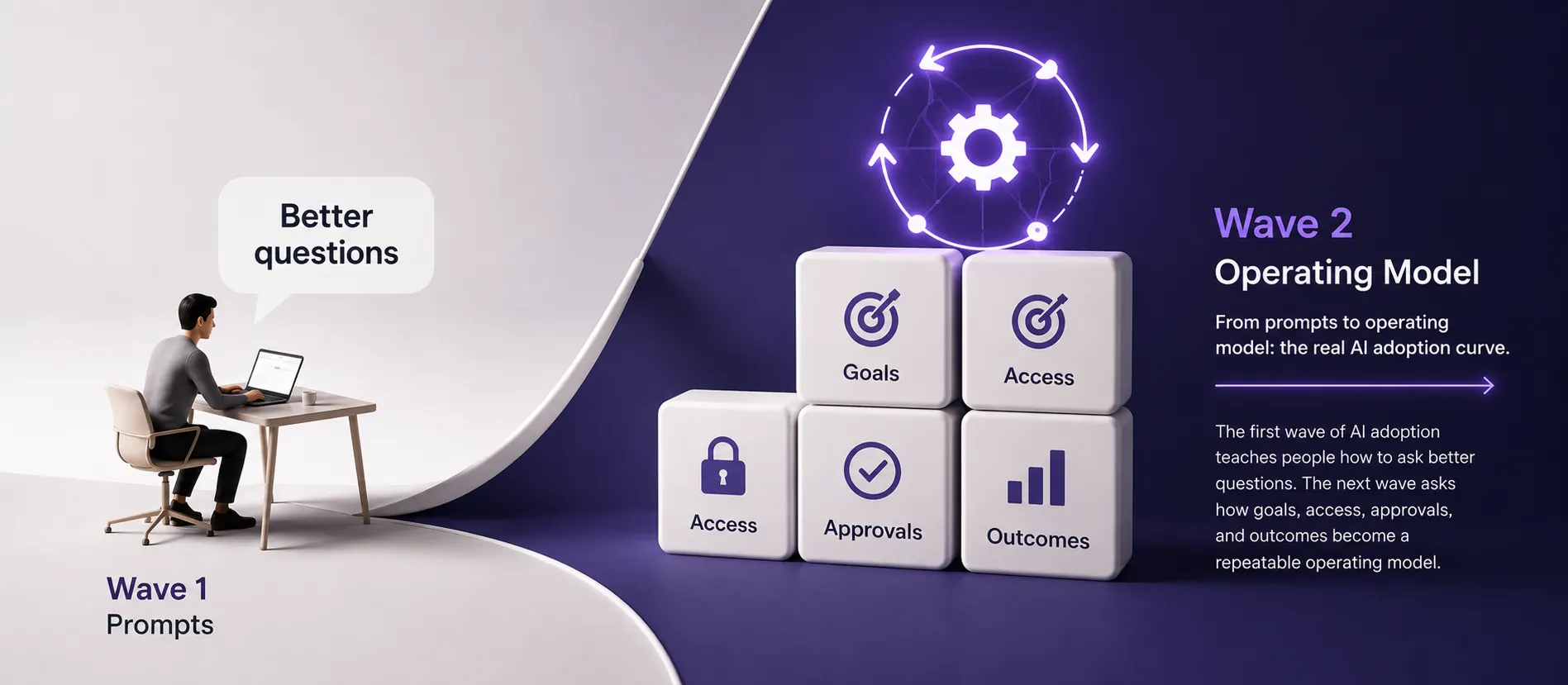
The first wave of AI adoption teaches people how to ask better questions. The next wave asks how goals, access, approvals, and outcomes become a repeatable operating model.

Key takeaways
- Prompt literacy is useful, but it does not by itself create operational leverage.
- The adoption curve matures through ownership, systems access, approval design, and measurement.
- The repeatable unit becomes a governed goal, not an isolated prompt.
Prompt literacy was a necessary first chapter. People needed to learn how to ask models for help, how to refine context, and how to judge outputs.
But prompts do not create an operating model by themselves.
An operating model answers different questions:
- Which goals can be delegated?
- Who owns the agent?
- What systems can it access?
- Which actions require approval?
- What evidence must be captured?
- How is success measured?
The unit of work changes
In prompt-based adoption, the unit is the interaction. A person asks, receives, edits, and moves on.
In governed execution, the unit is the delegated goal.
That goal can span systems and time. It can pause for a decision. It can produce an outcome and an audit record.
Teams need a portfolio view
Once goals are delegated, leaders need to see the work portfolio:
Goal type          Owner          Risk gate       Success metric
Renewal packet     Sales Ops      Pricing         Cycle time
Invoice review     Finance        Payment         Exceptions resolved
Access request     IT             Privilege       Time to fulfillment
Onboarding pack     People Ops     Personal data   Completion rate
This is not a prompt library. It is a governed work catalog.
The next maturity step
The next stage of AI adoption will be less about who has access to a model and more about which work is safe to delegate.
That is where the operating model matters. It lets teams scale use without scaling uncertainty at the same pace.