Governed AI for small business: automation lean teams can trust
Small teams have the most to gain from AI agents and the least room for a mistake. Governed AI gives a lean business the leverage of automation without giving up oversight.

Key takeaways
- Small teams gain the most from AI agents but can least afford an unsupervised mistake.
- Governed AI means agents act inside explicit limits, with approvals on anything sensitive.
- Start with one bounded workflow, keep the approval gates, and widen scope on evidence.
For a small business, every hour spent on routine admin is an hour not spent on customers or product. That is why AI agents are so appealing to lean teams: the promise is real leverage without a bigger headcount. It is also why the risk feels sharp. A ten person company does not have a compliance department to catch an automated mistake before it reaches a customer or a bank account.
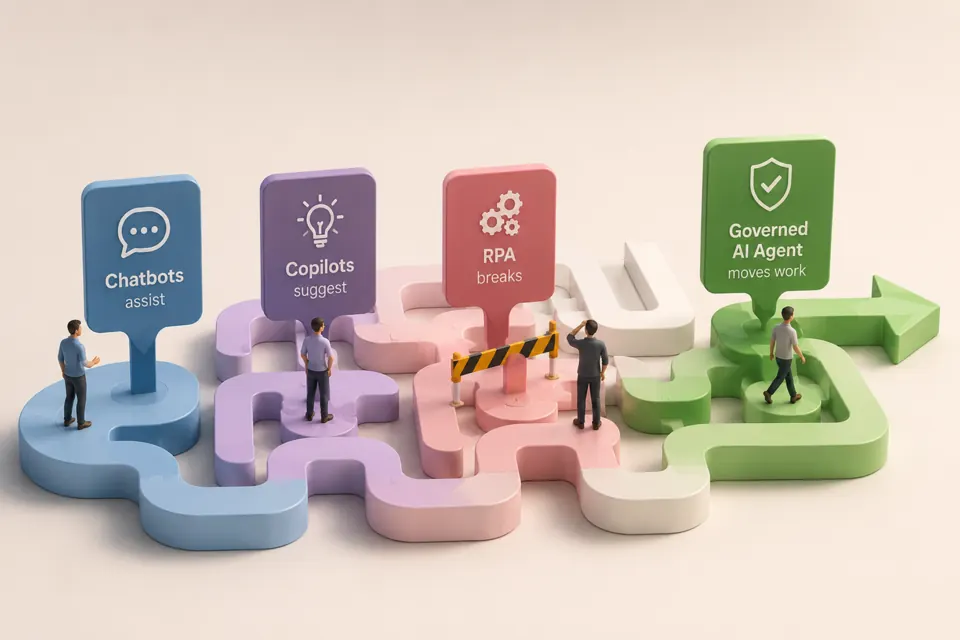
Governed AI for small business is the answer to that tension. It is not a bot you switch on and hope for the best. It is an agent that does real work inside limits you set, asks before it does anything sensitive, and records what it did. You get the leverage of automation and you keep the oversight that a small operation cannot afford to lose.
What “governed” actually means
The word governed is doing a lot of work, so it is worth being concrete. A governed AI agent has three properties that an ungoverned one does not.
It operates inside a defined scope. You decide which systems it can touch, which actions it can take, and where its authority stops. It requests approval for anything that crosses a line you have drawn, such as sending money, emailing a customer, or changing a record that matters. And it leaves an audit trail, so every action it took can be reviewed later.
Put simply, an ungoverned bot acts and you find out afterward. A governed agent acts within limits, pauses at the boundaries, and shows its work. For a small business, that difference is everything.
Why small teams are the strongest case, not the weakest
There is a common assumption that governance is an enterprise concern and small businesses should just move fast. In practice the opposite is closer to true.
A large company can absorb an automation error. It has reviewers, insurance, and slack in the system. A small business often cannot. One wrong invoice sent to every client, or one customer email with the wrong tone, does real damage to a brand that is still being built. The team that most needs speed is also the team that can least afford an unsupervised mistake.
Governance resolves that by letting a small team delegate the volume of work while keeping a hand on the decisions that carry risk. It is what makes AI agents usable for a business that does not have a safety net.
Where to point it first
The best starting point for governed AI in a small business is a workflow that is repetitive, rule-based, and currently eating time. A few common ones:
Sorting and drafting responses to inbound email and support requests, where the agent prepares replies and a person sends anything nonstandard. Preparing invoices and chasing overdue ones, with approval required before anything goes out. Handling expenses and receipts against a simple policy. Keeping records in sync across the handful of tools the business actually uses.
In each case the pattern is the same. The agent does the assembly and the routine handling. The owner or manager keeps the final say on the parts that touch money, customers, or compliance.
How to adopt it without losing sleep
You do not need a governance framework or a consultant to start. You need one workflow and a clear boundary.
Pick a single task that is costing you hours. Write down, in plain language, what the agent is allowed to do on its own and what must come to you first. Run it in a mode where you approve every action to begin with, so you can see how it behaves on your real work. As the decisions prove out, let it handle the clearly safe cases automatically and keep the approvals exactly where your risk lives.
This is deliberately incremental. You expand what the agent does based on what you have seen it do, not on a promise. And because every step is recorded, you can always look back and understand what happened.
The takeaway
Governed AI for small business is not a watered down version of enterprise automation. It is the version that actually fits how a lean team has to operate: real leverage on routine work, firm limits on anything sensitive, and a record you can trust. Start with one workflow, keep the approval gates where they matter, and let the agent earn a wider scope over time. That is how a small team gets the upside of AI agents without taking on risk it cannot carry.