Why governed autonomy is the missing layer in business AI
The jump from AI assistance to AI execution is not a model problem alone. It is an operating model problem: who owns the work, what systems can be touched, and how every action is reviewed.

Key takeaways
- The business gap is less about model intelligence and more about governed execution.
- Every AI agent needs identity, scoped access, approvals, supervision, policy, and audit.
- The right abstraction is not a smarter chat window. It is a controlled work system.
Most business AI adoption still begins in a chat box. A business user asks a question, receives a useful answer, and then does the actual work somewhere else: in a CRM, a spreadsheet, a contract tool, an ERP, or a long email thread.
That is a real gain, but it is not yet work execution. The business does not only need better answers. It needs work to move through approved systems without losing control.
The gap between advice and work
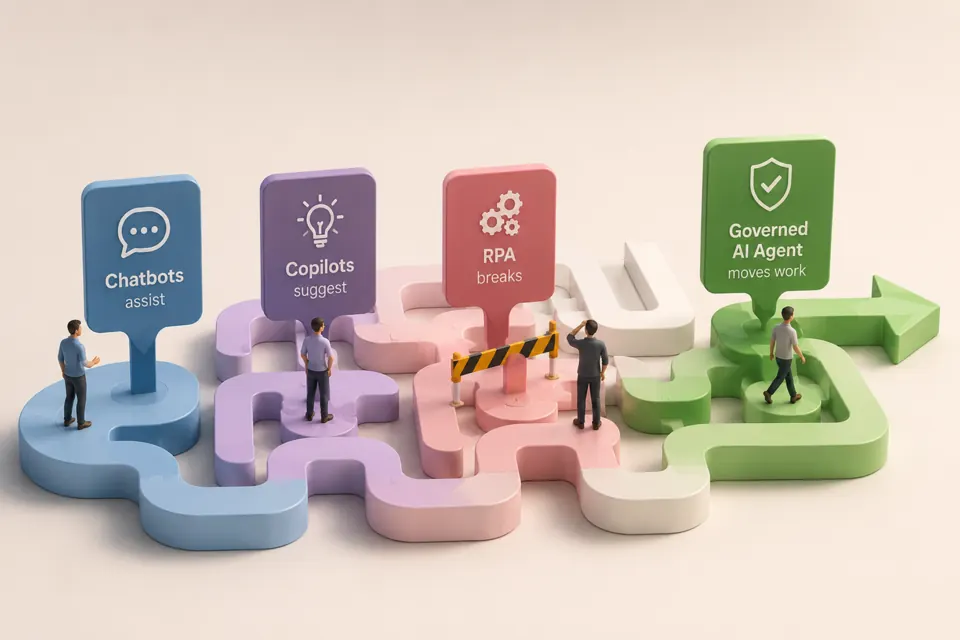
A chatbot can summarize a renewal packet. A copilot can suggest the next step. A workflow tool can run a narrow path that was designed in advance.
But many business goals are messier than that. “Prepare the renewal packet for this customer” might involve checking usage, reviewing contract terms, drafting a pricing exception, asking finance for approval, updating CRM fields, and notifying the account owner.
The hard part is not generating the first draft. The hard part is deciding what the AI agent is allowed to touch, when it must stop, and what evidence it must leave behind.
What governed autonomy adds
Governed autonomy is the layer that makes AI work execution business-ready. It treats control as part of the product, not as a PDF policy written after the fact.
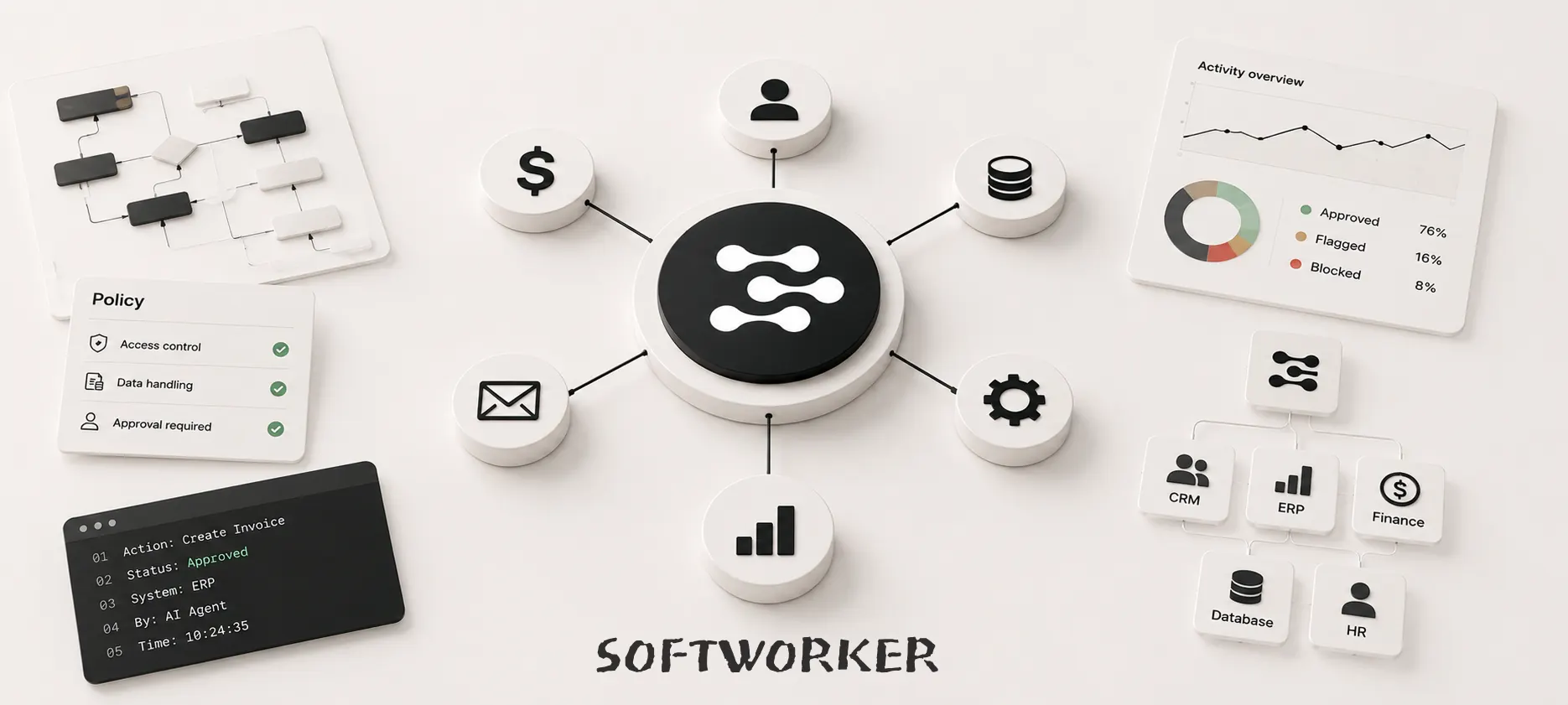
At minimum, that means six primitives:
- Identity: every AI agent has a name, an owner, and an accountable scope.
- Access: every tool and data source is explicitly permitted.
- Approvals: high-risk or irreversible actions pause for a human decision.
- Supervision: a run can be inspected, paused, or cancelled.
- Policy: organizational rules shape the plan before execution begins.
- Audit: decisions, actions, inputs, and approvals are reconstructable later.
Those primitives are not ceremony. They are what allow a business to let AI leave the chat window.
The operating model changes
The user’s job also changes. Instead of steering every click, the user delegates a goal and reviews the plan.
That creates a cleaner division of labor:
Human: owns the goal, context, judgment, and approval.
AI agent: plans the work, gathers inputs, executes permitted steps, and records evidence.
SoftworkerAI: enforces access, policy, supervision, and audit boundaries.
When this is done well, autonomy does not remove human control. It moves human control to the points where it matters.
Why this matters now
As models become more capable, the bottleneck shifts. Businesses will not ask, “Can the model draft this?” for very long. They will ask, “Can this AI agent complete the task safely inside our systems?”
That question cannot be answered with prompt engineering alone. It needs product architecture.