Chatbots assist, copilots suggest, RPA breaks: what actually moves work
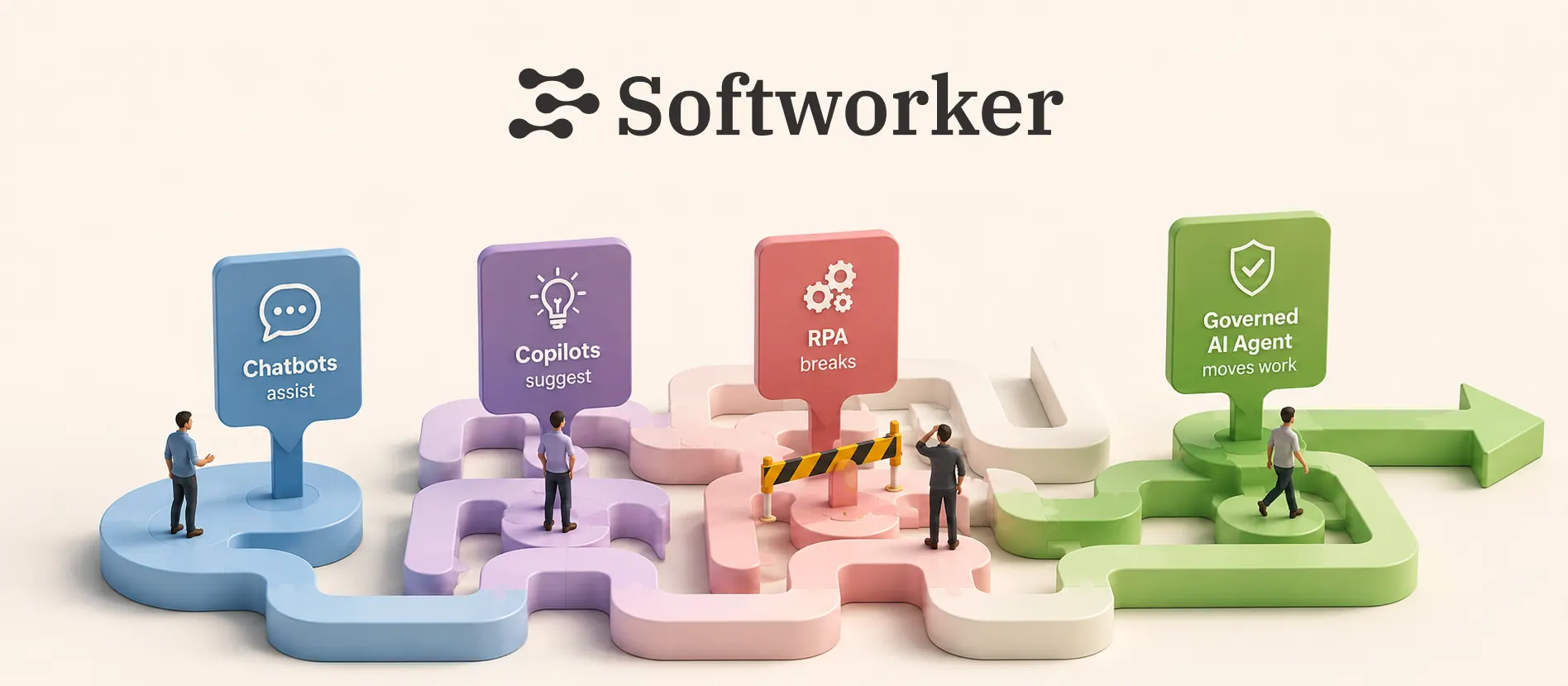
Different AI and automation categories solve different parts of the work problem. The missing category is the governed AI agent that can plan, pause, execute, and produce evidence.

Key takeaways
- Chatbots, copilots, RPA, and governed AI agents each sit at different levels of execution.
- The business needs systems that can handle ambiguity without losing boundaries.
- The category shift is from assistance at the edge to governed work inside systems.
Most business AI conversations collapse several categories into one word: automation.
That makes the market noisy and the internal strategy harder than it needs to be. A chatbot, a copilot, a workflow automation, and a governed AI agent are not the same tool with different branding. They sit at different levels of responsibility.
Chatbots answer
Chatbots are useful when the work is primarily informational. They retrieve, summarize, explain, compare, and draft.
They are strongest when the user remains in the driver’s seat. The person asks, evaluates, copies, pastes, edits, and performs the action elsewhere.
That is a good pattern for research and synthesis. It is not enough for recurring operational work.
Copilots suggest
Copilots sit closer to the work surface. They can suggest a CRM update, draft a response inside an inbox, or recommend a next step in a product interface.
The user still steers the flow. That makes copilots approachable, but it also means the user is the orchestration layer.
RPA follows a fixed path
RPA is valuable when the route is predictable. It automates stable, repetitive actions across user interfaces.
The weakness is brittleness. When the process changes, the screen changes, or an exception appears, the automation often needs maintenance.
Governed AI agents execute scoped goals
A governed AI agent starts with a goal, not a script. It builds a plan, checks its allowed systems, routes sensitive steps for approval, and records the outcome.
That agent should not have unlimited freedom. Its usefulness depends on constraints:
Goal: prepare the renewal packet.
Allowed systems: CRM, contract repository, usage dashboard.
Approval required: discounts above policy or external send.
Evidence required: contract terms, usage trend, pricing rationale.
That is a different operating surface. The user delegates the outcome while the system enforces boundaries.
A simple test
Ask one question of any AI or automation tool:
Can it move work through more than one approved system, stop when risk changes, and show exactly what happened?
If the answer is no, it may still be useful. It is just not yet a governed AI agent.