The five shapes of multiplayer AI: which one suits where
Most products say they are multiplayer the moment two people can see the same chat. The shape of the collaboration decides what breaks first, and what control the product needs.

Key takeaways
- Multiplayer AI is not one thing. The number of people and agents sharing a piece of work defines five distinct shapes with different failure modes.
- Each shape breaks in a predictable place first: visibility, review capacity, contention, shared control, or authority leaking through delegation.
- Choose the shape from the work being done, not from ambition. Individual drafting, shared intake, cross-functional operations, and cross-boundary processes each suit a different shape.
- Shapes compose. A product that handles many people and many agents on one piece of work must still support a single person working privately.
- The control needed grows with the shape. Identity, scoped access, approvals, live supervision, and audit stop being optional once more than one person depends on an agent's output.
“Multiplayer” has become a word products reach for the moment two people can see the same chat window. That is a thin definition, and it hides the thing that decides whether a product works for a team: the shape of the collaboration.
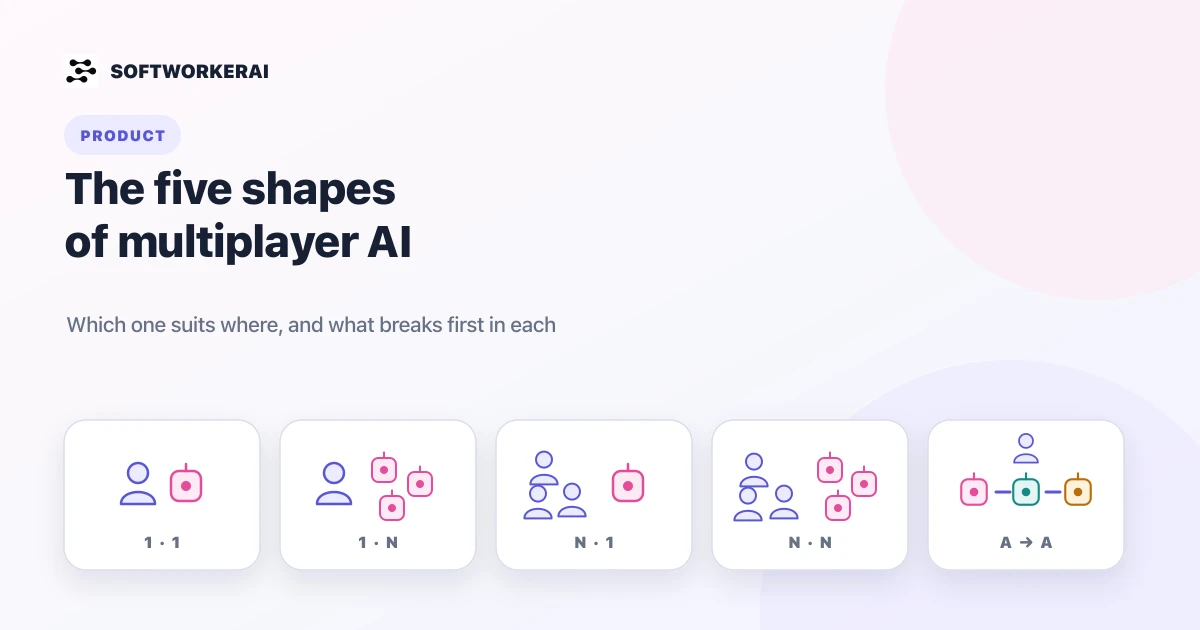
The shape is set by two numbers. How many people share a piece of work, and how many agents act on it. Change either number and the product changes underneath you. What needs to be visible changes. Who has to approve changes. What breaks first changes.
There are five shapes worth naming. Most products are one of them, drifting toward another without noticing. This post describes each shape, where it suits, and what gives way first when it is pushed past its limits.
Shape one: one person, one agent
This is the assistant. A person opens a session, works with one agent, and closes it. Nothing leaves the session unless the person copies it out.
It is fast, private, and easy to reason about. The person sees everything the agent does because there is nowhere else for it to be. Review capacity is not a problem because the output is small and the reviewer is the only consumer.
Where it suits. Individual drafting, research, summarising, exploring a problem before committing to it. Anything where the person is the sole owner of the result and the result does not touch a shared system.
What breaks first. Visibility. The moment the output matters to someone else, the session’s privacy becomes a liability. A teammate cannot see what was asked, what was assumed, or why the output looks the way it does. Work done this way is real, but it is invisible to the organisation, and invisible work cannot be governed, audited, or reused.
Shape two: one person, many agents
One person fans work out to several agents. A research agent, a drafting agent, a checker. Sometimes the person orchestrates by hand; sometimes a lead agent orchestrates on their behalf.
This shape is where “agentic” products tend to live. The output multiplies. The person’s job shifts from doing the work to reviewing it.
Where it suits. Personal productivity at scale: a researcher triangulating sources, an analyst preparing several cuts of a report, a developer running parallel explorations. The person remains the single owner and the single consumer.
What breaks first. Review capacity. Five agents can produce more than one person can read with care. The person starts skimming. Then they start approving on the strength of a summary. The system is now producing output faster than it is being checked, and the quality of the whole depends on the one place where attention is thinnest. Products in this shape need to make the review cheap, structured, and honest about what was and was not checked.
Shape three: many people, one agent
A team shares a single agent. It might be a service desk agent that triages requests, a finance agent that handles expense exceptions, or a team-level assistant that several people send work to.
This is the first genuinely multiplayer shape, and it is often the first one an organisation adopts because it looks like a familiar thing: a shared service with an inbox.
Where it suits. Shared intake and routing. Work that arrives from many directions and needs consistent handling: tickets, requests, approvals that follow a fixed pattern. The agent is a shared resource, and the value comes from consistency.
What breaks first. Contention and attribution. Two people send conflicting instructions. The agent acts on one and the other person does not find out until later. Someone asks who told the agent to do that, and the answer lives in a transcript nobody owns. Shape three needs the agent to have an identity of its own, a visible queue, and a record that says which person’s request produced which action. Without that, the shared agent becomes a shared liability.
Shape four: many people, many agents
Several people and several agents work on the same piece of work at the same time. A procurement request passes through a drafting agent, a policy-check agent, a reviewer, an approver, and a finance agent, with teammates watching and intervening along the way.
This is the hard shape. It is also the shape that most real business work has, because business work is cross-functional by nature. Nobody completes a supplier renewal alone, and no single agent should either.
Where it suits. Operational work that crosses functions and systems: onboarding, procurement, claims, incident response, quote-to-cash. Work where several people are accountable for different parts and several agents do different parts.
What breaks first. Shared control. Shared context is the easy half; people have had shared documents for years. The hard half is deciding, in a way everyone can see, what an agent may do, who may stop it, and who approved what. Without shared control, shape four degrades into a room full of people shouting at a room full of agents, with no record of who said what. This shape needs identity for every actor, scoped access for every agent, approval gates on sensitive actions, live supervision, and an audit trail that writes itself as the work happens.
Shape five: agents with agents, people supervising
Agents delegate to other agents, sometimes across team or organisational boundaries, and people supervise the result rather than each step. An internal procurement agent asks a supplier’s agent for a quote. A support agent hands an entitlement correction to the billing platform’s agent.
This shape is arriving quickly as interoperability between agents improves. It is also the shape where the most authority moves with the least human attention.
Where it suits. Processes that cross organisational boundaries or span several vendors’ systems, where every participant already has a specialist agent and the humans want outcomes rather than steps.
What breaks first. Authority. An agent was scoped for one task. It delegates to a second agent that was never scoped at all. The second agent delegates again. Three hops later something is acting on behalf of the organisation with no clear mandate and no human who knows. Shape five needs scope that travels with the task, a record of every hop, and a way for a person to pause the whole chain, not just the agent they can see.
Which shape suits where
The shapes are not a ladder to climb. They are a fit to find. The table below is a starting point, not a rule.
| Work | Shape | Why |
|---|---|---|
| Individual drafting and exploration | One person, one agent | Sole owner, private result, no shared systems touched |
| Personal research or analysis at scale | One person, many agents | Sole owner, but output exceeds what one pass of review can cover |
| Shared intake, triage, routing | Many people, one agent | Consistency matters more than depth; the agent is a shared service |
| Cross-functional operational work | Many people, many agents | Several accountable people, several specialist agents, shared state |
| Cross-boundary or multi-vendor processes | Agents with agents, people supervising | Participants already have agents; humans want outcomes, not steps |
Two patterns show up when teams try to apply this.
Products drift upward. A product built for shape one gets a “share” button and becomes a weak shape three. A product built for shape three adds a second agent and becomes a weak shape four. Each drift inherits the next shape’s failure mode without the control that shape needs. A chat window with sharing is not a workspace, and a shared inbox with two bots is not a governed system.
Work moves between shapes. A person drafts a request privately with one agent, then moves it into a shared space where a reviewer, an approver, and two more agents join. That transition from shape one to shape four is normal, and it is where context, authority, and history are most often lost. The product should carry all three across the boundary rather than asking the person to paste a summary.
Control grows with the shape
The reason to name the shapes is that the control needed is not the same across them, and it is not optional past a certain point.
In shape one, the person is the control. In shape two, the control is the quality of the review surface. From shape three onward, control has to be built into the system because more than one person depends on what the agent does:
- Identity. Every agent acts as a named actor, distinguishable from every person and every other agent.
- Scoped access. Each agent can reach only the systems and data it has been permitted to use for this work.
- Approval gates. Sensitive, financial, legal, or external actions pause for a named person before they complete.
- Live supervision. Work is visible while it runs, not discovered after the fact.
- Audit. Every run produces a record of steps, evidence, and outcomes that a person who was not in the room can read.
None of this is exotic. It is what organisations already expect from people who act on their behalf. The shapes simply make it clear when the same expectations start to apply to agents.
Where we are exploring
Most of the business work we care about has shape four: several accountable people and several specialist agents on one piece of work, with shape three as the common entry point and shape five arriving as agents learn to talk to each other.
At SoftworkerAI we are exploring what a workspace looks like when it treats shape four as the default rather than the exception, with the single-player shapes as a natural way in rather than a separate product. We do not think the answer is a bigger chat window. We think it is a shared place where people and agents are both visible, both accountable, and both subject to the same controls. If you are working through the same question, we would like to hear what you are finding.
The takeaway
Multiplayer AI is not one thing. It is five shapes, set by how many people and how many agents share a piece of work. Each one suits different work and breaks in a different place first. Pick the shape from the work, build the control the shape needs, and design the moments where work moves from one shape to the next. That is most of what separates a product that a team can rely on from one they quietly stop using.