Designing a multiplayer AI workspace for human teams and agents
Adding an assistant to a chat window does not make a workspace where humans and AI agents work together. Six design decisions do, and most of them are about control rather than capability.

Key takeaways
- A multiplayer AI workspace is a shared surface, not a chat window with an assistant attached.
- Agents need identity, scoped access, and a container for their work before they can be teammates.
- Long-running agents make this urgent, because a run that lasts days will outlive the person who started it.
- The design decisions that matter most are about control and evidence, not model capability.
A multiplayer AI workspace is a shared environment where people and AI agents work on the same items, see the same context, and operate under the same controls. It is not a chat window with an assistant attached, and that difference turns out to matter far more than which model sits underneath.
Most teams meet AI through a chat box. One person opens a session, describes a problem, pastes in some context, gets an answer, and copies the useful part somewhere else. That loop works well enough for one person doing one thing. It falls apart the moment the work belongs to a team, because everything that made the loop work, the context, the reasoning, the decision, lives inside a session nobody else can open.
So the interesting design question is not how to make the assistant smarter. It is what a workspace has to look like once agents stop being a feature inside someone’s tab and start being participants in the team’s work.
Why does a chat window stop working once a team is involved?
Because a chat window is a single player surface, and every property that makes it pleasant for one person makes it useless for several.
That creates three predictable failures. Context fragments, so two people ask the same agent the same question and get answers built on different facts, with nobody wrong and nobody able to explain the disagreement. Work becomes invisible, so a manager cannot tell what the agent did, what it was asked, or whether anyone checked it. And accountability blurs, because the only record of a consequential decision is a chat log in a personal account.
None of those are model problems. A better model produces a better answer inside the same broken container. They are workspace problems, and they need workspace answers.
Why is an AI agent a participant rather than a feature?
Because the useful mental shift is to stop treating an agent as a capability the product offers and start treating it as an actor the workspace has to account for.
Participants have names. They have permissions. They are assigned things, they hand things back, they get reviewed, and they leave a trail. Every workplace system already knows how to handle a participant like that, because that is what an employee account is. An agent needs the same treatment, with tighter limits, because it acts faster and does not pause to wonder whether it should.
This is the difference between an assistant and a governed AI agent, and it is also what separates this category from chatbots, copilots, and RPA. Once you accept the framing, most of the design work follows. The question stops being what the agent can do and becomes what the workspace must provide so that what it does is safe, visible, and reviewable.
What does the workspace have to provide?
Six things, and only the first is about capability.
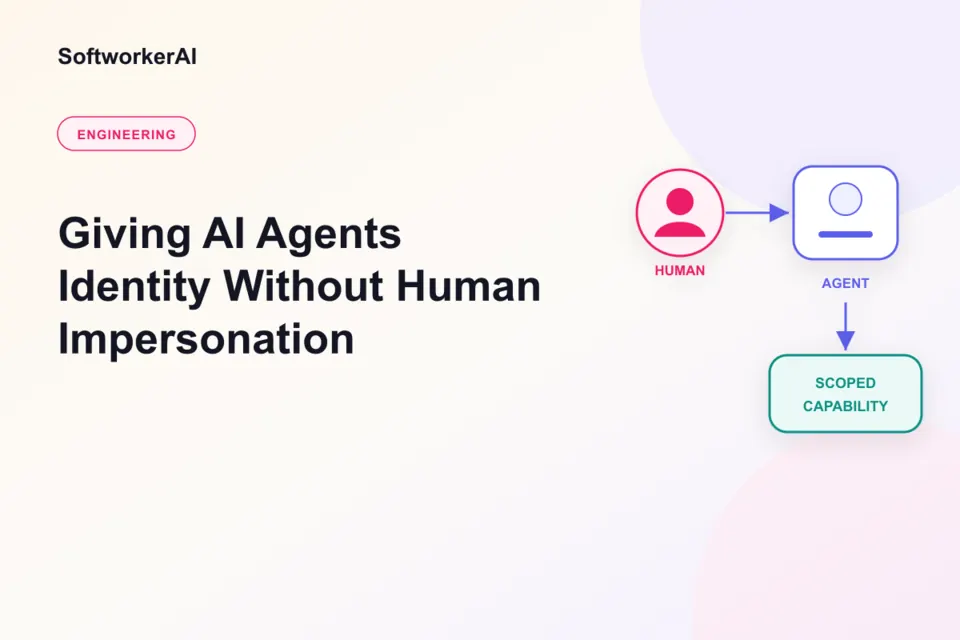
Agents need identity. An agent should be a named actor with a defined role, not an anonymous process running under a person’s credentials. When an agent acts, the record should say which agent, under whose delegation, and with what mandate. Without that, no audit question has an answer.
Work needs a container. A message is not a unit of work. A request that arrives from email, a form, Slack, or a direct instruction needs to become an item with an owner, a state, a history, and a place where everyone involved can see it. Once work has a container, both people and agents can be assigned to it, and progress becomes something you look at rather than something you ask about.
Context has to be shared rather than pasted. If the agent’s understanding of a policy, a customer, or a process depends on what somebody remembered to paste, the workspace is still single player. Agents need governed access to the documents, policies, and process notes the team already relies on, respecting the same access rules a person would face.
Control belongs inside the flow. Approval cannot be an afterthought living in another tool. When an agent reaches an action that is sensitive, irreversible, external, or expensive, the work should pause where it is, present the approver with the context and the recommendation, and wait. Approving should take seconds because the preparation is already done.
The record has to write itself. Nobody reconstructs an audit trail voluntarily. The workspace should capture the goal, the plan, the steps, the evidence, the retries, the failures, the approval, and the outcome while the work is running, because that is the only moment the information is complete and free.
Supervision has to be live. A weekly export is not oversight. Leaders need to see what agents and people are working on right now, what is waiting, what is stuck, and where the approval queue is backing up, in one view.
How do long-running agents change the design?
They turn all six from nice to necessary, because a run that lasts hours or days will outlive the attention of whoever started it.
This is the part of the shift Y Combinator highlighted when it put multiplayer AI on its request for startups in 2026. Aaron Epstein makes the operational point directly: “Anyone on a team should be able to drop into the same live agent session to watch it work, redirect it, and hand it off, the way they’d work with any other human team member.”
Design for that and three requirements appear that a short chat exchange never surfaces. Handoff has to be first class, because the person who started the run may be asleep when it needs a decision. Redirection has to be attributable, because if a second person changes the instruction mid run, the record needs to show who changed what and when. And the pause has to be safe, because an agent that keeps acting while it waits for an answer is not really waiting.
The uncomfortable implication is that live shared sessions raise the governance requirement rather than lowering it. More hands on a running agent means more need to know whose hand did what.
What does this look like in practice?
SoftworkerAI is a multiplayer AI workspace built around exactly that list, so the product surfaces map onto the six requirements one for one. That makes it a concrete example rather than an abstraction, whether or not you end up using it.
In SoftworkerAI, requests from Slack, Microsoft Teams, email, forms, webhooks, and direct instructions land in a personal and shared inbox, so work has one front door instead of six. Each request becomes an intent card routed to the right workstream, agent, and skill. From there it becomes a collaborative work thread where the agent, the requester, reviewers, and approvers are all looking at the same item, and where the run trace shows the steps, evidence, artifacts, blockers, and retries behind what the agent did.
Sensitive actions pause at an approval gate inside that thread. Agents themselves are created with explicit roles, tools, permissions, memory, skills, and approval rules, so scope is a property of the agent rather than a hope about its behavior. Boards show work in stages such as running, waiting, and done, so a leader can see the state of agent work across departments without asking anyone. And the knowledge hub gives agents controlled access to company documents, policies, and process notes, so shared context is a setting rather than a habit.
The point of listing them together is not the feature count. It is that each exists to answer a specific failure of the single player loop, and that they only work as a set. Approvals without an audit trail leave you unable to prove what you approved. An audit trail without scoped access records a breach in great detail. Shared context without identity means you cannot tell who reached what.
Where should a team start?
With one workflow, not one department. The rollout that works is narrow and boring on purpose, and it follows the same shape as our guide to adopting governed AI agents.
Pick a workflow where the rules are written down and the volume is real. Put the agent in a prepare-only posture first, where it does the reading, gathering, and drafting, and a person reviews every result. Watch the run traces for a couple of weeks, because they will show you where your process is actually ambiguous. Then widen autonomy only on the parts that proved reliable, and keep the approval gate exactly where the risk sits rather than where it is convenient.
Teams that expand this way end up with agents doing more, not less, because every widening is backed by evidence somebody can point at.
The takeaway
A multiplayer AI workspace is a governance design problem wearing a collaboration costume. The shared surface, the containers, the routing, and the visibility are what make agents usable by a team. Identity, scoped access, approval gates, live supervision, policy, and audit are what make them safe enough to keep.
Build only the first half and you get a faster way to produce work nobody can vouch for. Build both and agents become something a team can actually rely on, which is the only version of this that survives contact with a real business. That conviction is why SoftworkerAI ships governance and collaboration as one surface rather than two, and the platform is currently in early access.
For the argument behind the category, read multiplayer AI: what changes when a whole team works with agents. If you are evaluating tools rather than designing one, the next read is how to evaluate an AI agent collaboration platform.