Multiplayer AI: what changes when a whole team works with agents
Google Docs beat Word by going multiplayer. Figma beat Photoshop. AI has not had that moment yet, and the missing piece is not shared context. It is shared control.

Key takeaways
- Multiplayer AI means a team and its agents share one live session rather than one private chat each.
- Single player AI hides context, work, and accountability inside one person's tab.
- Multiplayer AI needs three things at once: shared presence, shared context, and shared control.
- Shared control is the dimension most products skip, because agents can act on real systems.
Multiplayer AI is software where several people and several AI agents work together on the same piece of work at the same time, in one live shared session, with the same context and the same controls. It is the opposite of the pattern almost everyone uses today, which is one person, one chat, one answer that nobody else can touch.
Y Combinator named this as a request for startups in 2026. Aaron Epstein opens the argument with a piece of software history that is hard to argue with: “The best work tools of the last two decades won by going multiplayer. Google Docs replaced Microsoft Word. Figma beat Photoshop.” His point is that AI has not had that moment. “AI agents are the most powerful new tool a team has, but it’s the one thing people still use by themselves.”
That is the right diagnosis. The part worth adding is what the multiplayer version actually requires, because AI needs something Docs and Figma never did. It is the reason we built SoftworkerAI the way we did, and it is the argument this piece is really about.
What is multiplayer AI?
Multiplayer AI is a shared, live work surface where humans and agents are both participants. Three properties define it. Several people can be present in the same agent session. Everyone, human and agent, draws on the same approved context. And everyone who can act does so inside limits the workspace enforces.
The word is borrowed from collaborative software, and the analogy holds for the first two properties. What made Google Docs win was not that two people could type at once. It was that the document stopped living on somebody’s laptop and became the shared source of truth, after which everything downstream, review, comments, version history, reorganized itself around that fact. Figma did the same thing to design files and made handoff stop existing as a separate ritual.
The third property has no precedent in those tools, and it is the reason multiplayer AI is harder than multiplayer documents.
How is multiplayer AI different from multi-agent AI?
Multi-agent AI means agents coordinating with each other. Multiplayer AI means humans and agents coordinating with each other. They are frequently confused and they solve different problems.
A multi-agent system can be entirely single player. A developer wires five agents into a graph with planning, tool calls, retries, and handoffs between them, and the whole thing still runs inside one person’s session while everyone else waits for a summary. The agents collaborate beautifully. The team does not.
Multiplayer is a claim about who is inside the work, not about how many agents there are. One agent and four people in a shared session is multiplayer. Twenty agents and one person watching a log is not.
Why is most AI still single player?
Because the products were built around the chat session as the unit of everything, and a chat session is structurally private.
The engineers at PowerSync put the diagnosis well in an essay on this exact question: “The model supports collaboration. The product does not.” AI outputs get treated as ephemeral chat responses rather than as first-class data in the application, so the work stays trapped inside a private conversation.
The consequences arrive in a predictable order. Context fragments first, because two people ask the same model the same question and get different answers built from different piles of pasted background. Then work becomes invisible, because a manager cannot see what was asked, what was produced, or whether anyone checked it. Then accountability blurs, because the only record of a consequential decision lives in a personal account. And finally adoption stalls exactly where it was supposed to pay off, since agents get used for drafts and summaries where mistakes are cheap, and never for the work that actually moves.
That last one is worth sitting with. It is the real reason so many agent pilots look excellent and never reach production. The capability was never the constraint. The container was.
What does multiplayer AI need that Google Docs did not?
Control. In a design file, the worst a collaborator can do is move a rectangle. In an agent session, one of the participants can send the contract, issue the refund, update the customer record, or release the payment.
That difference changes the product requirement completely. Multiplayer AI means the ability to act is shared across humans and agents, and anything shared that powerful needs shared limits. So a multiplayer AI product is a governance product whether or not it is sold as one.
This is where most of the current wave stops short. The multiplayer workspace framing that has emerged over the past year is largely about shared context and real-time visibility, which are necessary and not sufficient. Vendors defining multiplayer AI for enterprises mostly stop at persistent shared context and reusable agents. Anthropic’s own guidance on human and agent teams goes further on the working relationship but leaves the enforcement question to the platform.
The unanswered question in all of it is simple and operational. If three people can redirect a long-running agent mid run, who is accountable for what it does next?
What does shared control actually mean?
It resolves into six controls that either exist in the workspace or do not.
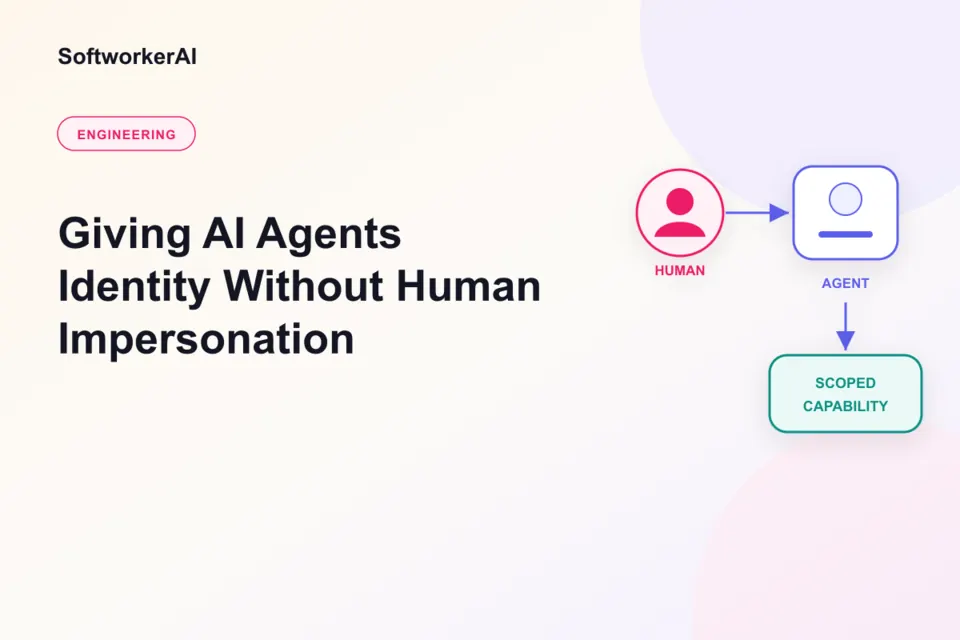
Identity, so every agent is a named actor with a role and a mandate rather than a process borrowing a person’s credentials. Scoped access, so what an agent can reach is a configured boundary rather than an emergent property of how somebody prompted it. Approval gates, so sensitive, irreversible, external, or expensive actions pause in place and wait for a person who can see the full context and the recommendation. Live supervision, so a leader can see what is running, what is waiting, and what is stuck right now rather than in next week’s export. Policy, so the same rules apply across agents and workflows instead of being reimplemented per use case. And audit trails, so the goal, plan, steps, evidence, retries, failures, approval, and outcome are recorded while the work runs, which is the only moment that record is complete and free to capture.
They fail as a set, which is why they are worth naming as one. Approvals without audit trails leave you unable to prove what you approved. Audit trails without scoped access give you a beautifully detailed record of a breach. Identity without policy tells you who acted but never whether they should have. Half a governance model is not half as safe, it is differently unsafe. The longer version of that argument is in governed versus ungoverned AI agents.
What does multiplayer AI look like inside a product?
SoftworkerAI is a multiplayer AI workspace where people and governed AI agents work on the same items in one shared surface, under six controls that apply to every actor in it. The product is organized around the three dimensions above rather than around a feature list, so it is a reasonable worked example of what each one costs to build.
Presence comes from work having a container. Requests arrive from Slack, Microsoft Teams, email, forms, webhooks, and direct instructions into a personal and shared inbox, become intent cards routed to the right workstream, agent, and skill, and open into collaborative work threads where the agent, the requester, reviewers, and approvers are all looking at the same live item. Boards show that same work in stages such as running, waiting, and done, so the state of agent work across departments is something you look at rather than something you ask about.
Context comes from a knowledge hub that gives agents controlled access to company documents, policies, SOPs, and process notes inside existing access rules, and from extensions that let agents retrieve from and update the systems teams already use, with access scoped by workspace, agent role, and risk level.
Control comes from agents being created with explicit roles, tools, permissions, memory, skills, and approval rules, from approval gates that pause sensitive actions inside the thread, from run trace and evidence showing the steps, artifacts, blockers, retries, and failures behind every run, and from an impact dashboard reporting run volume, cost, turnaround time, approval rate, and rework so that decisions about widening autonomy rest on evidence.
None of that is exotic. It is what any team already expects from the systems where consequential work happens, which is the point. SoftworkerAI exists because agents arrived in the workplace without any of it.
How do teams go multiplayer without a big bang?
Pick one workflow where the rules are already written down and the volume is real. Move that one into the shared surface, with the agent in a prepare-only posture where it does the reading, gathering, and drafting while a person reviews every result.
Then spend two weeks reading run traces rather than counting hours saved. They will show you where your process is genuinely ambiguous, which is information you did not have before and cannot get any other way. Widen autonomy only on the parts that proved reliable, and leave the approval gate where the risk actually sits rather than where it is convenient. The full sequence is in how to adopt governed AI agents safely.
Teams that expand this way end up granting agents more scope, not less, because every widening is backed by evidence somebody can point at in a meeting.
The takeaway
Multiplayer is not a collaboration feature you bolt onto an AI product. It is a claim about where the work lives. For documents and design, going multiplayer meant the artifact became shared. For AI it means something harder, because some of the participants can reach your systems, so presence and context have to arrive together with control.
Shared presence makes agent work visible. Shared context makes it consistent. Shared control makes it something a business can keep. Build the first two alone and you get a very fast way to produce work nobody will vouch for. Build all three and the workspace becomes where the work actually happens, which is the only outcome that earns the word multiplayer.
If you are evaluating products in this category, the six questions worth asking are in how to evaluate an AI agent collaboration platform. If you are designing one, the requirements are in designing a multiplayer AI workspace. If you want to work this way now, SoftworkerAI is in early access, and the first cohort gets full platform access at no cost.